Institute of European Studies   Contact Search Sitemap
               
About
Calendar
Grants and Fellowships
Programs
Publications
Research
Resources


A Virtual Grand Tour  in June

Cal Extension is offering a class this summer examining the long tradition of the European Grand Tour, de rigueur for the 18th century privileged. The course enables Bay Area residents to relive their experiences, venture out to explore the arts of the continent over bad roads, perilous waters and high mountains, and add contemporary perceptions of Paris, Versailles, and Italy’s great cities Florence, Venice, Naples and Rome, to their understanding of the practice. Get to know art treasures and the historical contexts in which the tours were spawned, and understand why they inspired the travellers. It is taught by Birgit Urmson. For more information, go here.


Euro Future Panel Image


Conference

The Future of the Euro:
Lessons from History

Tuesday, April 16, 2013

At a time when the recent economic upheaval of Cyprus, Greece, and Spain has been in the news, IES was pleased to host a conference considering the history and future of the Euro.

Cosponsored by IES, the EU Center of Excellence, the Austrian Marshall Plan Foundation, and the Austrian National Bank, it was held at the University of California, Berkeley at the Faculty Club. Prominent economists and historians from Berkeley, the US, and abroad discussed this topical issue in front of a large, interested audience and press.

The Conference focused on the following questions: Will the Euro survive? Should it? Will the current crisis lead to the banking, fiscal, and political union ultimately required for monetary union and envisioned when the euro was created? Or will current efforts to stabilize the monetary union with only limited moves in the direction of banking, fiscal and political union suffice to save the Euro? Is there danger that pressure for deeper integration will only worsen the “democratic deficit problem” and create a backlash against the larger European project?

For complete information about the Conference, including program information and locations, please go here.

This event was sponsored in part by the European Union.


Portuguese Republice Book Cover

Publication of the Portuguese Republic at One Hundred

Proceedings from a conference and exhibit held at UC Berkeley in March 2010 have been edited and published in a book available on our e-scholarship site or for purchase from Lulu.com. Under the coeditorship of Professor Emeritus Richard Herr and former Distinguished Portuguese Studies Visiting Scholar António Costa Pinto, the volume was assembled with the support of the Portuguese Studies Program at Cal (one of the constituent IES Country Programs) under the guidance of Executive Director Deolinda Adão and Chair Professor G. Mathias Kondolf.

The book examines the Republics which arose after the exile of the monarchy early in the 20th century, life under the Dictatorship, and various cultural aspects of Portuguese civic life such as women's rights, entrepreneurship, public policy, and the Church. Assistance for the conference, the Bancroft Library exhibit at UC Berkeley, and the publication of this volume came also from the National Organization for the Commemoration of the Centennial of the [Portuguese] Republic, the Camões Institute, the Luso-American Foundation, and the Consul General of Portugal in San Francisco, for which IES is grateful.


Sheehan Lecture

First Gerald D. & Norma Feldman Annual Lecture

James J. Sheehan, Dickason Professor in the Humanities, Professor of Modern European History, Emeritus, Stanford University

Eminent historian of Germany and Europe, James Sheehan gave the first Gerald D. and Norma Feldman Annual Lecture Thursday, November 29th, at the Faculty Club, to a packed audience of friends, colleagues, and students of former IES Director Gerald Feldman. Introduced by current Director John Efron, Prof. Sheehan engaged in an analysis of means of fixing and qantifying the state during the Englightenment. Norma Feldman was in attendance and joined in the reception afterward. James Sheehan is the author of Where Have All the Soldiers Gone?: The Transformation of Modern Europe and German History, 1770-1866 (Oxford History of Modern Europe), among many other volumes. His talk was titled ‘The Origins of the Legible State: Mapmaking, Census Taking, And Codification in Early Modern Europe.’


Gregor Gysi Poster

The Significance of November 9th and Beyond
Gregor Gysi, Distinguished Member of the German Parliament

Distinguished Member of the German Parliament, Gregor Gysi, spoke on the significance of the November 9th in Germany history to a large audience in Stephens Hall on November 9, 2012. His address in German focused on four major events which took place on that day during the last 100 years, including an aborted democratic proclamation in 1918, Kristallnacht, and the Fall of the Berlin Wall, and how these events should be considered and remembered in historical discourse.

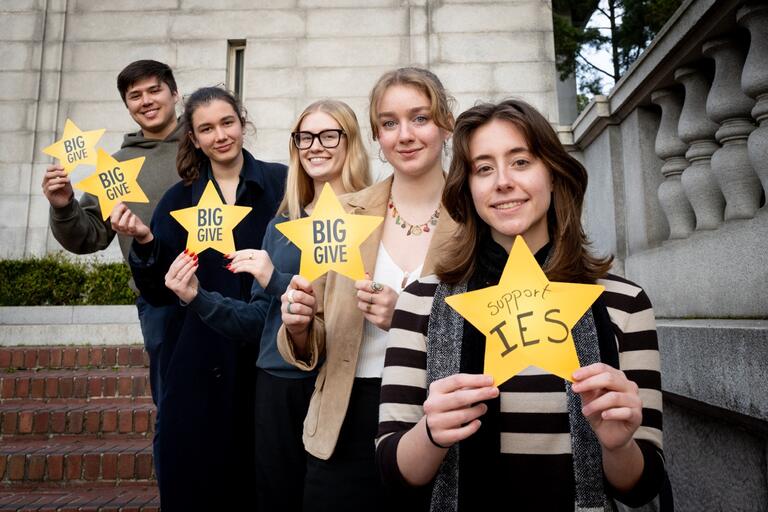
Please Consider Donating to IES!

We welcome your ongoing interest and participation in our public events, lecture, and conferences. And please don’t forget to support IES though donations and your estate! We rely upon your support to sustain our innovative public program, support scholars and students, and maintian our pertinent contributions to scholarship

Go to the IES News Archive...

University of California
         
Copyright © Institute of European Studies 2011. All rights reserved.